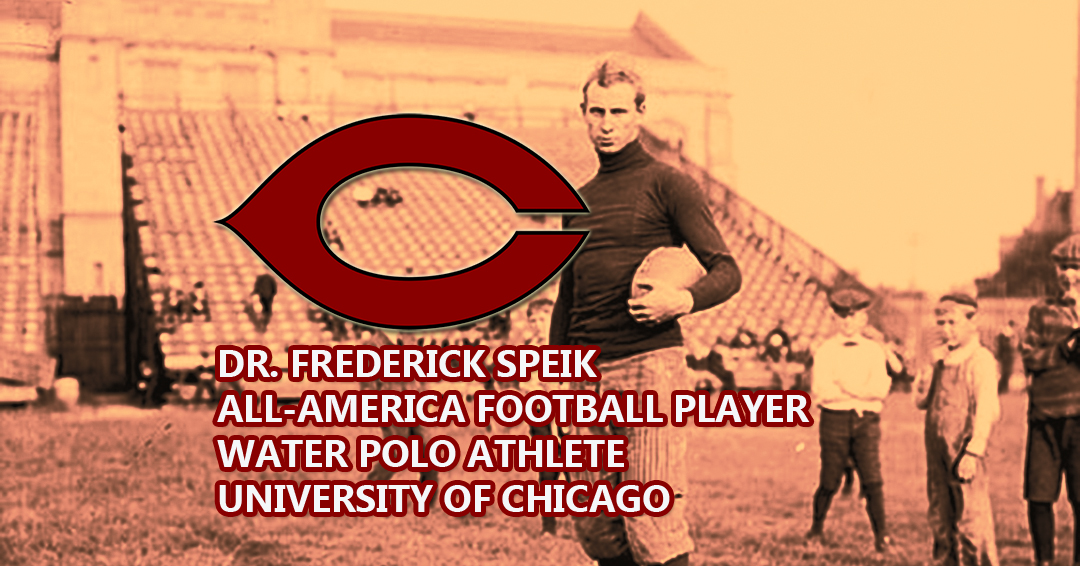

BRIDGEPORT, Pa. — In a continuation of the league’s efforts to highlight unknown/minimally known/remembered athletes who competed during the early days of collegiate water polo, the Collegiate Water Polo Association (CWPA) highlights the story of University of Chicago alumnus/former Purdue University head football coach Frederick Adolph Speik.
Born on January 26, 1882 in Stockton, Calif., to a manufacturer and grocer, Speik is best remembered for his success not in the pool, but on the gridiron as a football player and coach. He played for the University of Chicago from 1901 to 1904 and was selected as a first-team All-American in 1904. He was the head football coach at Purdue University from 1908 to 1909, compiling a record of 6–8.
A graduate of Northwest Division High School in Chicago, Illinois, Speik enrolled at the University of Chicago in 1901 and played four years of college football there under legendary coach Amos Alonzo Stagg. He also played for Chicago’s water polo and track teams. As a football player, he played at the left end position and was captain of the 1904 team. The Chicago Daily Tribune called him “one of the best ends ever developed at Chicago.” At the end of the 1904 season, Speik was selected as a first-team All-American by Caspar Whitney in Outing magazine.
After graduating from Chicago in 1905, Speik served as an assistant football coach under head coach Stagg. Speik attended Rush Medical College at Chicago while working as an assistant football coach. He graduated from medical school in 1907.
In 1908, Speik accepted the job as the head coach of the Purdue University Boilermakers football team and served there in the 1908 and 1909 college football seasons. He compiled a 6–8 record in two years at Purdue and resigned his position as head coach on October 23, 1909. At the time of his resignation, the Chicago Daily Tribune reported: “Since Speik has been in charge at the Boilermaker institution, Purdue has not won a game of note, and his ability as an instructor did not meet the expectations of members of the association, who assert that Speik had splendid material from which to pick an eleven.”
After retiring from football, he joined the practice of his medical school mentor Dr. Bertram Sippy, inventor of the Sippy diet and Sippy powder (calcium and sodium bicarbonate) for treatment of peptic ulcers. Dr. Speik served as Dr. Sippy’s assistant from 1909-1912, at which time Fred moved his family–and his practice–to South Pasadena, bringing Dr. Sippy’s treatment regime to greater Los Angeles.
Speik’s Los Angeles practice flourished and he became the personal physician to prominent citizens and movie stars, including John Barrymore, who suffered from peptic ulcers. He faithfully advocated the Sippy Diet taught to him by his mentor, believing it to be a preventive as well as a cure for stomach ulcers. The Sippy Diet is based on a theory that the stomach can be protected from the ravages of acid by coating it with fat, particularly dairy fat. Patients are instructed to consume three ounces of a milk-and-cream mixture every hour from 7:00 a.m. until 7:00 p.m., and one soft egg and three ounces of cereal three times a day. This bland, fatty regimen is accompanied by large doses of magnesia powder and sodium bicarbonate powder. Unfortunately, the Sippy Diet remained popular for decades – until it was proven in papers during the 1960s that followers of the Sippy Diet were suffering heart attacks at twice the rate of patients who did not follow the diet. Eventually the medical profession realized that frequent meals of any kind result in the release of stomach acid, and therefore the Sippy Diet actually made ulcers worse – in addition to having disastrous effects on cardiac health. However, the diet was so entrenched in medical practice that it dominated ulcer treatment for six decades despite having no beneficial effect whatsoever.
During his time in California, Speik was on the staff of the Los Angeles County Hospital and the Pasadena Hospital and was a professor of medicine at the University of Southern California Medical School from 1915 to 1919. In 1917, he was Chairman of the Los Angeles County Medical Association’s Committee on the County Hospital. He was active in South Pasadena civic and political affairs. In 1938, he received a patent for an ornamental spoon holder.
Following some alleged financial difficulties brought on by investments in the wake of the Great Depression and suffering from angina, Speik’s body was discovered hanging by a heavy cord attached to one of the machines at a surgical supply factory in South Pasadena in June 1940. His death was ruled a suicide.
In 2017 he was inducted into the University of Chicago Athletics Hall of Fame.